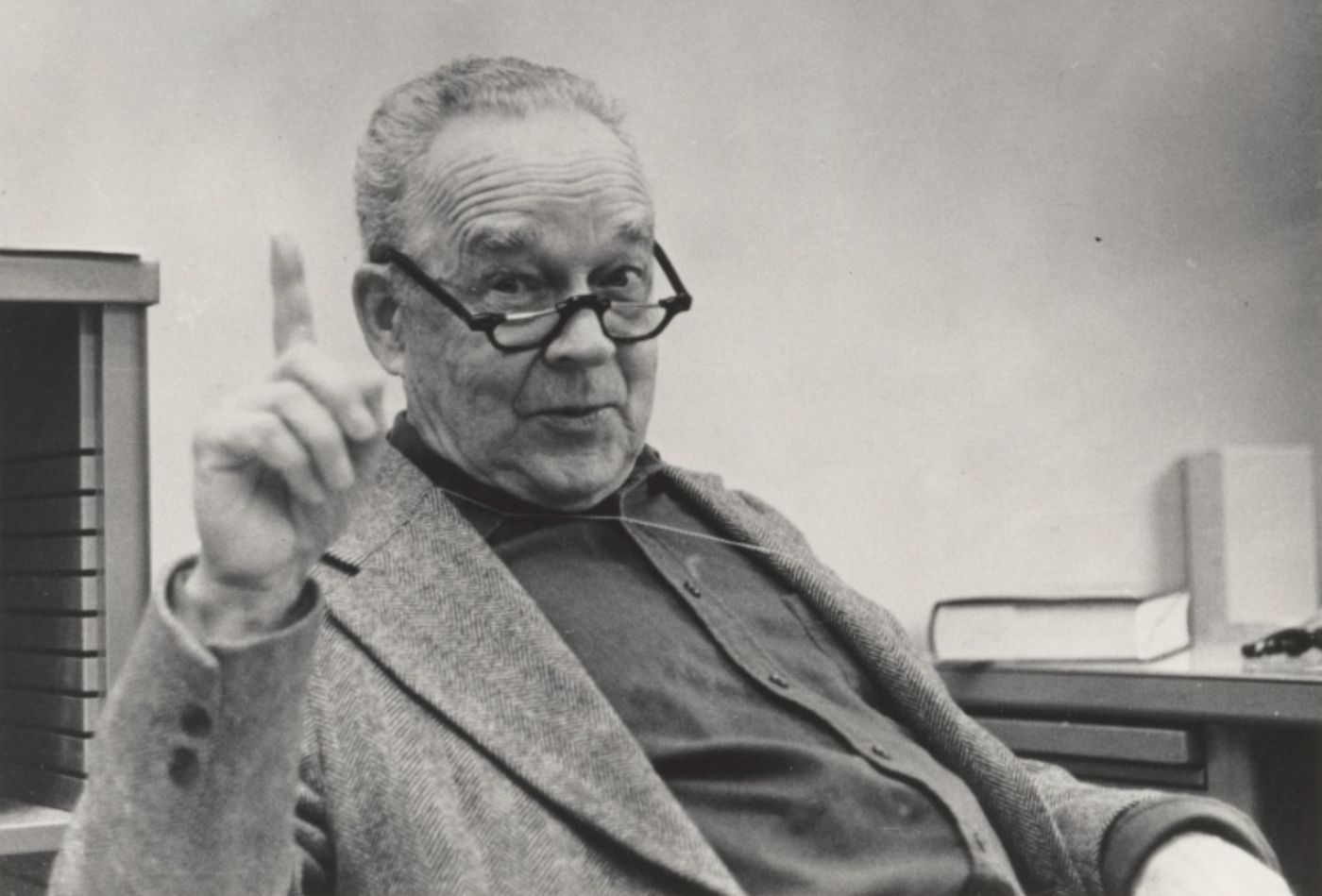
In memoriam J. J. Gibson (1904 – 1979)
Consider an environment in which a given animal dwells, and contemplate the relation between the animal and that environment. Even when the environment seems still, there would be numerous objects and motions in the environment to perceive and utilize by an animal, i.e. to interact with (Capra & Luisi, 2014). Furthermore, the cognitive state of an animal during those interactions would be very complex to understand or map. For decades, scientists and philosophers roamed on how to identify and reveal this relation, the systemic and complex perceptual problem (Schultz & Schultz, 2011). In those days, from the initial formulation of psychology as a science by Wundt and nearly seven decades, the main tools or perspectives to analyze and understand such complex phenomena had not yet been developed. After the Second World War, however, things started to change, especially due to the formulations of J. J. Gibson, who proposed the ecological approach to perception, which clearly diverged from the earlier “ancient” view.
The main tenet proposed by Gibson was that an animal perceives the world and the surroundings as what is offered to that animal, compared to the orthodox view of perception in which an animal sees, constructs, and then perceives the environment (Gibson, 1986). In this view, an animal is a passive perceiver: light comes to the eyes, passes through several paths such as the optic nerve and the lateral geniculate nucleus (LGN), and finally reaches the primary visual cortex (Jessell et al., 2021). After this journey, the information is constructed and valued thanks to the complex network of associative visual areas and other cortices, and voilà, the object or its surroundings are perceived. This is a highly deterministic outlook; it means that if the input is the same, such as light coming from the environment, then so is the output, perception. However, things are not that easy. As has been indicated, any complex layout, such as the human brain or the animal-environment interaction, can produce quite different outputs even when a slight difference occurs in the initial configurations (Mitchell, 2009). Treating complex systems as predictable and linear is one of the most persistent barriers in the sciences. Even though this outlook provides valid and enlightening information regarding how the process of visual perception is carried out, it does not specify and even consider what is perceived in the environment (McArthur & Baron, 1983). The theory of affordances facilitates our comprehension of this “what” in this respect, an attempt that is nearly unmatched in the history of psychology. This distinction, which should be considered a paradigm shift in the science of psychology, given how impactful and crucial the implications of this outlook are, is one of the reasons why Gibson is so important in the study of psychology (Shapiro, 2012).
Turning to the notion of affordances, what are those “what’s” that are perceived? Referring to affordances, the information obtained from the environment has a “value” for an animal, since the process of acquiring information is in general so crucial that even the life of an animal is tightly bound to this process (Stoffregen, 2003). In this phase, Gibson discussed several notions, such as the medium, substances, and surfaces; their constitution forms the foundations of ecological perception (Gibson, 1986). Therefore, examining them in a more integrated manner would be better. A medium is described as “…in which an animal can move about (and which) is at the same time the medium for light, sound, and odor coming from sources in the environment…” (p. 17). What Gibson means here is that it is the space-like, generally unrealized, normal entity in which the animal lives, and also something that enables the animal to interact with its surroundings. It is what air is for a terrestrial animal, and water is for a marine animal. Inside that air, an animal moves and sees; therefore, the medium, so to say, affords locomotion, vision, olfaction etc. Substances, on the other hand, are entities which in some degree are resistant to deformation, in a way that solids do. They can vary in hardness, cohesiveness, elasticity and so on, and in most are composed as nested units, such as snowflakes, which includes its main formation in its fine details. Speaking of the two, the surfaces, then, are the borders between the medium and substances. Gibson proposes ecological laws of surfaces, including characteristic texture, shape, and illuminative properties. This can be the color of an apple, or the smoothness of silk fabric. From the ecological perspective, these three notions create a meaningful environment for animals. To make all of those concepts clearer, consider a tiger roaming around in a jungle. First of all, the ground is very important for our tiger; it indicates where the “down” is and it affords something to be stepped on, to stand on. Other surfaces, such as those of trees and ponds, afford something to climb on and to drink from. Simultaneously, it perceives the substance texture, reflectiveness, and elasticity of those surfaces. All of the information coming from the environment, then, determines what is perceived in the first place. Moreover, while it perceives its environment as what the surfaces, substances, and the medium afford it, it also has to consider their velocity, which brings us to the point that we should think about movement.
Perception is inherently active and depends on exploration (Gibson, 1966). It is a hard-to-swallow claim, but as Gibson and studies in the literature of modern cognitive science insist, perception is a dynamic process; therefore, movement is considered the backbone of the Gibsonian approach (Noë, 2010). For example, even if an animal does not move at a given time at all, the saccadic movements of its eyes create changes in the optical ambient array, which is an easier way to say that it sees two different forms; however identical they are, there is a small, noticeable difference between those images (Gibson, 1986). Movement is very abundant in nature; objects and surfaces move and change, both proximally and temporally. Therefore, movement detection is so crucial that even basic single-celled organisms detect and behave accordingly in response to movement in the environment (Ogas & Gaddam, 2021). Movement, both of the animal itself and in the environment, packages information that is matter of life and death (Noë, 2004). Gibson even reflected his philosophical view of movement as such: “the animal that does not move is asleep – or dead” (Gibson, 1986, p. 43).
Events are related to movement because they involve it, but the main point Gibson indicated is that time, as we know it in physics, is not what organisms perceive. This is a highly brilliant claim. What is perceived are events, meaning, processes, changes, derivations and such. Some, of course, take most of the life of an animal such as rearing a baby, but some are very rapid; consider the visual changes of a campfire. Therefore, events are what is meaningful for an animal; bare physical time has little or no direct value for perception (Gibson, 1986).
In this respect, it should be taken that the process of perception is different from merely perceiving passively and in a meaningless way. Perception is an active, engaging, and, in this respect, a phenomenological process (Merleau-Ponty, 2002), which implies that a special meaning arises between the animal and what is being perceived, and “the meaning is observed before the substance and surface, the color or the form, are seen as such” (Gibson, 1986, p. 134).
In science, paradigm shifts are rare, and some shifts are not given their deserved respect. One of those theories is the one proposed by Gibson; and his philosophy will always be the cornerstone in understanding our environment, both in psychology and for broader sciences.
H. Berkay Demirel
References
Capra, F., & Luisi, P. L. (2014). The systems view of life: A Unifying Vision. Cambridge University Press.
Gibson, J. J. (1966). The senses considered as perceptual systems. Academic Press.
Gibson, J. J. (1986). The ecological approach to visual perception. Psychology Press.
Jessell, T. M., Siegelbaum, S. A., & Kandel, E. R. (2021). Principles of Neural Science (6th ed.). McGraw-Hill Medical.
McArthur, L. Z., & Baron, R. M. (1983). Toward an ecological theory of social perception. Psychological Review, 90(3), 215–238. https://doi.org/10.1037/0033-295x.90.3.215
Merleau-Ponty, M. (2002). Phenomenology of perception. Psychology Press.
Mitchell, M. (2009). Complexity: A Guided Tour. Oxford University Press.
Noë, A. (2004). Action in perception. MIT Press.
Noë, A. (2010). Vision without representation. In N. Gangopadhyay, M. Madary, & F. Spicer (Eds.), Perception, action, and consciousness: Sensorimotor dynamics and two visual systems (pp. 245–256). Oxford University Press.
Ogas, O., & Gaddam, S. (2023). Journey of the mind: How thinking emerged from chaos. W. W. Norton Company.
Schultz, D. P., & Schultz, S. E. (2011). A history of modern psychology (10th ed.). Wadsworth.
Shapiro, L. (2012). Embodied cognition. In E. Margolis, R. Samuels, & S. Stich (Eds.), The Oxford Handbook of Philosophy of Cognitive Science (pp. 118–146). Oxford University Press.
Stoffregen, T. A. (2003). Affordances as properties of the Animal-Environment System. Ecological Psychology, 15(2), 115-134. https://doi.org/10.1207/s15326969eco1502_2